

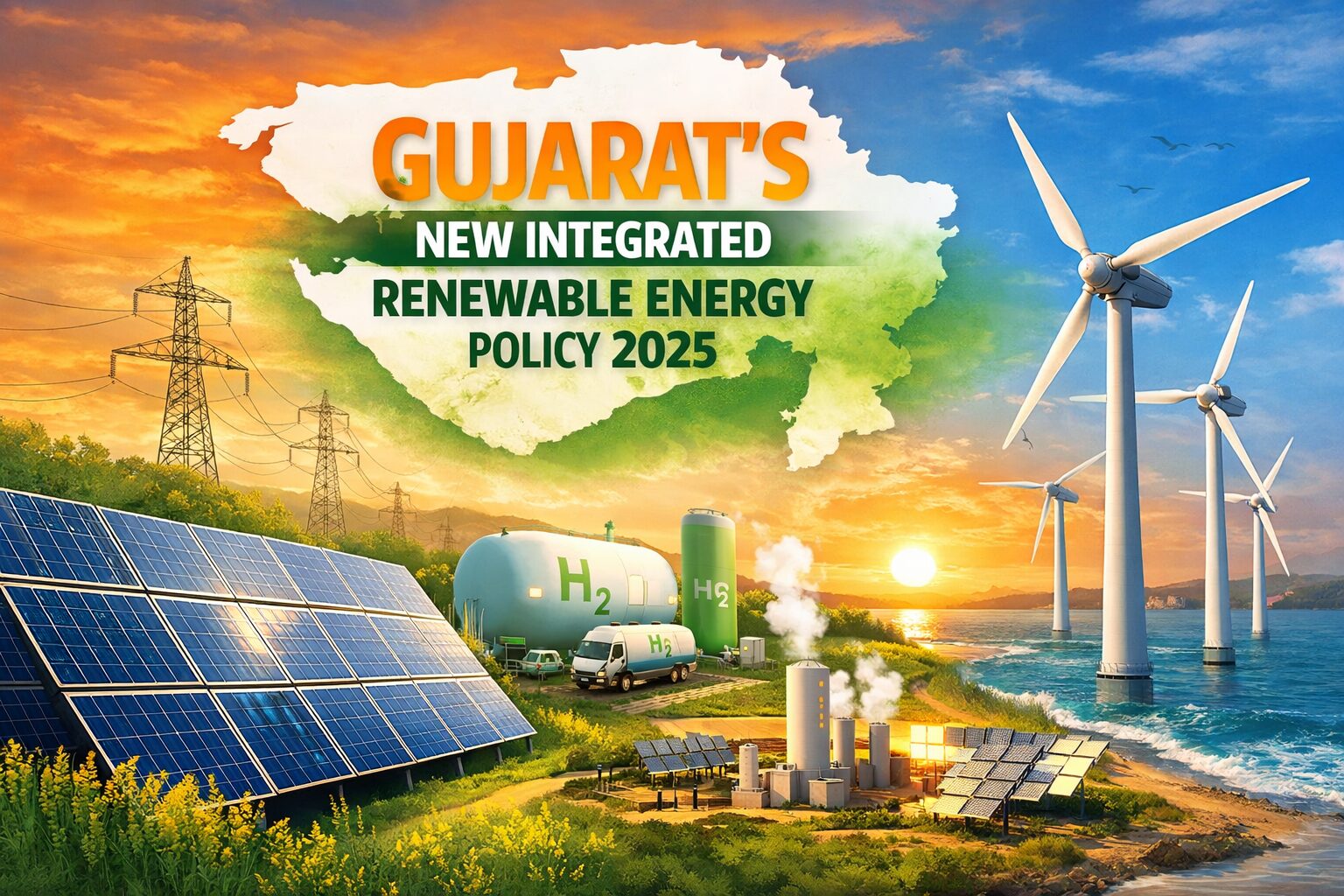
Gujarat has once again taken a bold step toward shaping India’s clean energy future. With the launch of the Gujarat Integrated Renewable Energy Policy 2025, the state has clearly signaled its intent to become a global renewable energy hub while supporting India’s ambitious climate and energy goals.
This policy is not just an update—it’s a comprehensive roadmap that brings together solar, wind, hybrid projects, battery storage, and emerging technologies under one unified framework. Let’s break down what this policy means, why it matters, and how it opens new opportunities for businesses, investors, and professionals in the renewable energy sector.
Why This Policy Matters Now
Climate change, rising energy demand, and global commitments like the Paris Agreement have made the transition to clean energy unavoidable. Gujarat, already a leader in renewables, understands that future growth must be:
- Sustainable
- Economically viable
- Technology-driven
- Inclusive
The 2025 policy aligns with India’s 500 GW non-fossil fuel capacity target by 2030 and supports the vision of Viksit Bharat@2047 and Viksit Gujarat@2047.
Gujarat’s Renewable Energy Journey So Far
Gujarat’s renewable energy growth is nothing short of remarkable:
- 2002: Just 0.16 GW of renewable capacity
- 2025: Over 41 GW installed
- 2030 Target: 100+ GW renewable capacity
Today, Gujarat contributes over 16% of India’s total renewable energy capacity, making it one of the strongest pillars of the national energy transition.
What Makes the Integrated Renewable Energy Policy 2025 Different?
Unlike earlier policies that focused on individual technologies, this policy integrates everything—from generation to storage to consumption.
1. Technology-Neutral & Inclusive Approach
The policy supports:
- Solar
- Wind
- Wind–Solar Hybrid projects
- Battery Energy Storage Systems (BESS)
- Ocean, tidal, and geothermal energy
- Agriphotovoltaics (Agri-PV)
This allows developers to choose the most efficient mix based on location, grid availability, and demand.
Strong Focus on Battery Energy Storage Systems (BESS)
One of the most forward-looking aspects of the policy is its strong emphasis on Battery Energy Storage Systems.
Why BESS matters:
- Solves the intermittency issues of solar and wind
- Improves grid stability
- Reduces dependency on fossil-fuel peaking plants
- Enables better load management
With storage becoming critical for large-scale renewable integration, Gujarat is positioning itself ahead of the curve.
Boost for Hybrid Projects
The policy actively promotes Wind–Solar Hybrid projects, both new and existing:
- Type-A Hybrid: Converting existing wind or solar plants into hybrid systems
- Type-B Hybrid: New hybrid projects with or without storage
Hybridization helps:
- Optimize land use
- Reduce power variability
- Improve transmission efficiency
- Increase overall project viability
Rooftop Solar & PM Surya Ghar Yojana Support
Gujarat continues to be a frontrunner in rooftop solar adoption. The policy aligns closely with PM-Surya Ghar: Muft Bijli Yojana, aiming to:
- Reduce household electricity bills
- Simplify approvals
- Improve DISCOM coordination
- Increase public awareness
This creates massive opportunities for EPCs, installers, and solar entrepreneurs at the residential level.
Business-Friendly Environment & Ease of Doing Business
The policy strengthens Gujarat’s reputation as an investor-friendly state by offering:
- Single-window clearances
- Dedicated nodal agencies
- Clear definitions and procedures
- Long-term policy stability (benefits up to 25 years)
It also supports startups, MSMEs, and technology innovators, making Gujarat an attractive destination for renewable energy manufacturing and services.
Agriphotovoltaics: Powering Farms & Food Together
A key innovation in the policy is the formal recognition of Agriphotovoltaics (Agri-PV).
This model allows:
- Solar power generation on agricultural land
- Continued farming under or around panels
- Additional income for farmers
- Efficient land utilization
Agri-PV has the potential to transform rural energy and agriculture economics.
Long-Term Vision & Policy Stability
- Policy validity: Till 31 December 2030
- Benefits applicable for 25 years from commissioning
- Replaces Gujarat Renewable Energy Policy 2023
- Ensures continuity for projects already under implementation
This long-term clarity builds confidence among investors, developers, and financial institutions.
What This Means for the Renewable Energy Industry
The Gujarat Integrated Renewable Energy Policy 2025 creates opportunities for:
- Solar & wind developers
- EPC companies
- BESS providers
- Technology manufacturers
- Startups & MSMEs
- Skilled professionals & technicians
More importantly, it moves the industry from capacity addition to system-level thinking, where generation, storage, and consumption work together.
Source: Gujarat Integrated Renewable Energy Policy 2025, Energy & Petrochemicals Department, Government of Gujarat.