

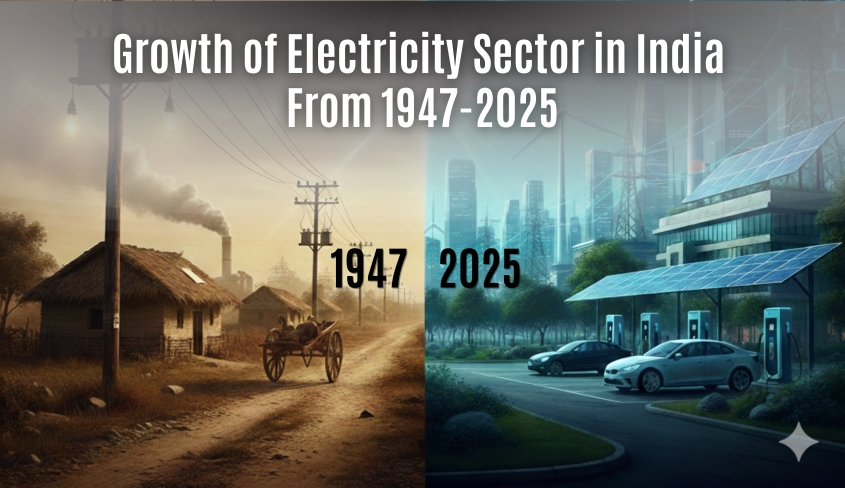
India’s growth story cannot be told without talking about electricity. From lighting a handful of urban streets before Independence to powering one of the world’s fastest-growing economies today, the Indian electricity sector has travelled a long and inspiring journey.
The latest publications by the Central Electricity Authority (CEA) clearly show how far we’ve come—and where we’re headed next .
A Humble Beginning After Independence
In 1947, India’s total installed electricity generation capacity stood at just 1,362 MW. Power supply was limited, unreliable, and mostly restricted to cities. Rural India remained largely in the dark, and electricity was considered a luxury rather than a basic necessity.
The formation of State Electricity Boards (SEBs) in the early 1950s marked the first major step toward organized power sector growth. Large hydro projects, followed by thermal power stations, slowly began shaping a national electricity backbone CEA All India Electricity Stati….
Planned Growth and Strong Institutions
India’s power sector expanded steadily through planned development. Each Five-Year Plan added new capacity, transmission lines, and access to electricity. A major turning point came in the 1970s with the creation of central power utilities such as NTPC (thermal), NHPC (hydro), NPCIL (nuclear), and later POWERGRID for transmission.
These institutions brought scale, technical expertise, and coordination—helping electricity reach more states and regions reliably CEA All India Electricity Stati….
The Electricity Act, 2003: A Game Changer
One of the most defining moments in India’s power sector history was the Electricity Act, 2003. This reform reshaped the industry by:
- Opening doors for private investment
- Introducing competition and power trading
- Allowing open access for large consumers
- Strengthening regulatory bodies
- Promoting renewable and environmentally friendly energy
This single reform accelerated capacity addition, improved efficiency, and laid the foundation for today’s competitive electricity market CEA All India Electricity Stati….
Installed Capacity: From MWs to Hundreds of GW
Fast forward to today, and the numbers are striking.
- Installed capacity (utilities only) as of March 2024: ~442 GW
- Total capacity including captive plants: Over 520 GW
- By March 2025 (estimated): ~475 GW (utilities)
Thermal power still forms a major share, but the real story lies in renewable energy growth. Over the last decade, renewable capacity (excluding large hydro) has grown at a CAGR of over 15%, reaching more than 143 GW by 2024 .
Electricity Generation: Powering a Growing Economy
Electricity generation has grown alongside capacity:
- 1950: ~5,100 GWh
- 2023–24: ~1,734,000 GWh (utilities only)
- Including captive generation: Nearly 2 million GWh
Renewable energy generation has seen especially rapid growth, reflecting India’s shift toward cleaner power sources while meeting rising demand from industry, homes, and agriculture CEA All India Electricity Stati….
Reaching Every Village: 100% Electrification
One of India’s proudest achievements is near-universal village electrification.
- Villages electrified in 1950: ~3,000
- Villages electrified by 2023: Over 597,000 (100%)
This milestone reflects decades of policy focus, infrastructure investment, and programs aimed at inclusive development .
Transmission & Distribution: The Silent Backbone
Electricity generation alone is not enough—it must reach consumers efficiently.
- T&D line length in 1950: ~29,000 circuit km
- By March 2024: Over 14.7 million circuit km
At the same time, system losses have gradually reduced, though they remain an area of focus. In 2023–24, overall system losses were about 17.6%, highlighting the ongoing need for grid modernization and smarter distribution systems CEA All India Electricity Stati….
Per Capita Consumption: A Measure of Progress
Per capita electricity consumption tells a powerful story of development:
- 1947: ~16 units
- 1950: ~18 units
- 2023–24: ~1,400 units
- 2024–25 (estimated): ~1,460 units
This steady rise mirrors improvements in living standards, industrial activity, and access to modern appliances—though it also signals future demand challenges Growth of Electricity Sector in….
The Road Ahead: Clean, Reliable, and Smart Power
India’s electricity sector has evolved from scarcity to relative adequacy, and now toward sustainability and resilience. The future focus is clear:
- Higher renewable energy penetration
- Energy storage and grid flexibility
- Smarter transmission and distribution
- Reliable power for a digital and electric-mobility-driven economy
The journey from a few megawatts to hundreds of gigawatts shows what long-term vision, policy support, and technology can achieve.