

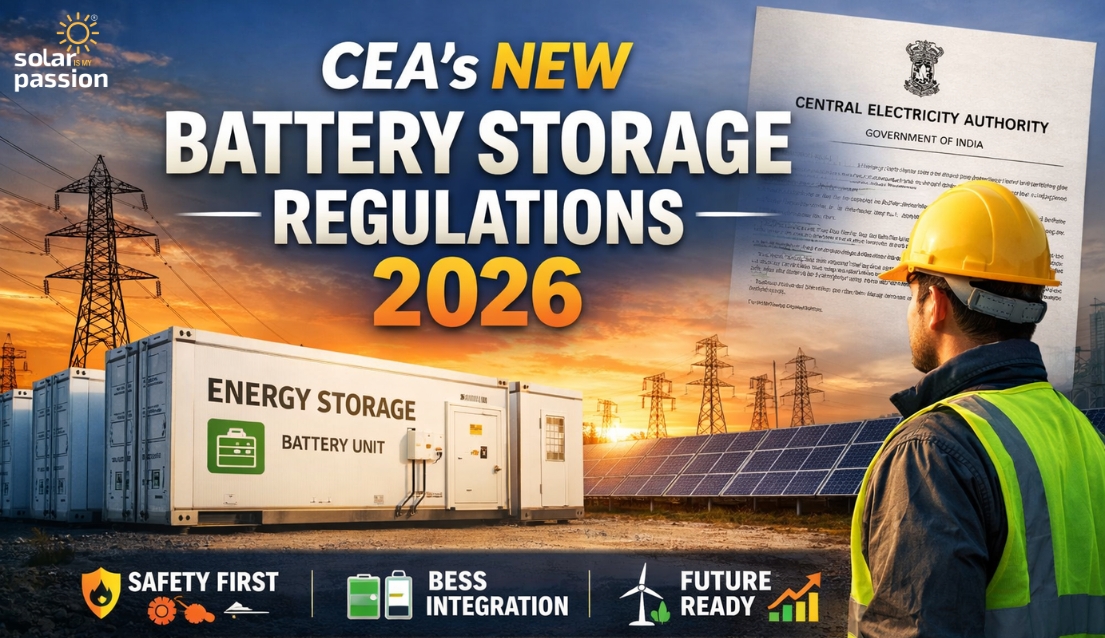
The Indian power sector is evolving rapidly. With the growing focus on renewable energy, especially solar, one thing has become very clear—energy storage is no longer optional, it’s essential.
On 27th March 2026, the Central Electricity Authority (CEA) introduced an important amendment to its safety regulations. At first glance, it may look like just another government notification. But if you are working in solar, EPC, or planning to enter the MW segment, this update is something you cannot afford to ignore.
Let’s break it down in a simple and practical way.
Why This Amendment Matters
Until now, most discussions in solar revolved around generation—how much power you can produce.
But the real challenge has always been:
What happens when the sun is not shining?
That’s where Battery Energy Storage Systems (BESS) come in.
With increasing solar capacity across India, the grid needs stability. And storage systems play a critical role in balancing supply and demand. The government understands this shift, and this amendment is a clear signal that BESS is going to be a major part of future projects.
What Exactly Has Changed?
The CEA has officially introduced a new dedicated chapter (Chapter XA) focused entirely on Battery Energy Storage Systems.
This means BESS is no longer treated as an “add-on”—it is now a regulated and structured part of the power ecosystem.
They have also clearly defined key components like:
- Battery Energy Storage Systems (BESS)
- Battery Management System (BMS)
- Power Conversion System (PCS)
- Walk-in containerized units
This clarity is important because it standardizes how projects will be designed and executed.
Focus on Safety – The Core of This Amendment
If there is one thing this regulation emphasizes again and again, it is safety.
And rightly so.
Battery systems, especially lithium-ion, can be risky if not handled properly. Fire incidents in energy storage projects globally have already raised concerns.
That’s why CEA has introduced strict safety requirements.
1. Two-Fault Tolerance System
The system must remain safe even if two failures happen simultaneously.
This is a big step. It ensures that even in worst-case scenarios, the system either continues safely or shuts down without causing damage.
2. Advanced Monitoring with BMS
The Battery Management System must continuously monitor:
- Voltage
- Temperature
- Current
- Thermal runaway
And not just monitor—
👉 It must trigger audio-visual alarms and even stop operations automatically if limits are exceeded.
This is a shift from reactive safety to proactive safety.
3. Fire & Explosion Protection
Safety is required at every level:
- Cell level
- Module level
- Rack level
- Container level
- Site level
Plus:
- Automatic fire suppression systems
- Smoke, gas, heat, and flame detection
This shows how serious the authority is about preventing accidents.
Design & Infrastructure Requirements
The amendment also focuses heavily on how these systems are physically installed.
Battery Containers
- Must have explosion protection systems
- Forced ventilation to release gases
- Proper pressure control
Ventilation & Cooling
- HVAC systems are mandatory
- If ventilation fails, the system must automatically shut down
Spacing & Layout
Proper distance must be maintained between:
- Battery containers
- Nearby buildings
This reduces the risk of fire spreading.
Security & Accessibility
This is something many people ignore, but CEA has addressed it clearly.
- Minimum 1.8-meter fencing required
- CCTV, motion sensors, and alarms
- Emergency lighting systems
- Clear signage for safe navigation
In simple terms, these sites must be treated like high-value, high-risk infrastructure.
Emergency Preparedness
Another strong focus area is emergency handling.
- Automatic shutdown in case of faults
- Manual emergency stop buttons
- Third-party fire safety audit (mandatory within 3 months)
Even fire departments will now be trained specifically for battery-related fire risks.
This is a much-needed step, especially as BESS installations increase across the country.
Earthing & Electrical Safety
No surprises here—but strict compliance is required.
Proper earthing of:
- Battery systems
- Equipment
- Associated infrastructure
This ensures both equipment protection and human safety.
What About Small Systems?
The regulation clearly differentiates between:
- Systems above 650V → Full compliance required
- Systems 650V and below → Must follow relevant standards
So whether it’s a large MW project or a smaller system, safety cannot be ignored.
What This Means for the Industry
If you are in the solar field, here’s the practical takeaway:
1. BESS is the Future
Large-scale solar projects will increasingly include storage.
If you are not learning this now, you may miss future opportunities.
2. Compliance Will Become Mandatory
This is not optional.
Every serious project will now need to follow these safety norms.
3. Skill Gap Will Increase
Most people still don’t fully understand:
- BESS design
- Safety systems
- Integration with solar
This creates a huge opportunity for those who prepare early.